Can a Model Tell When a Robot Touches Something?
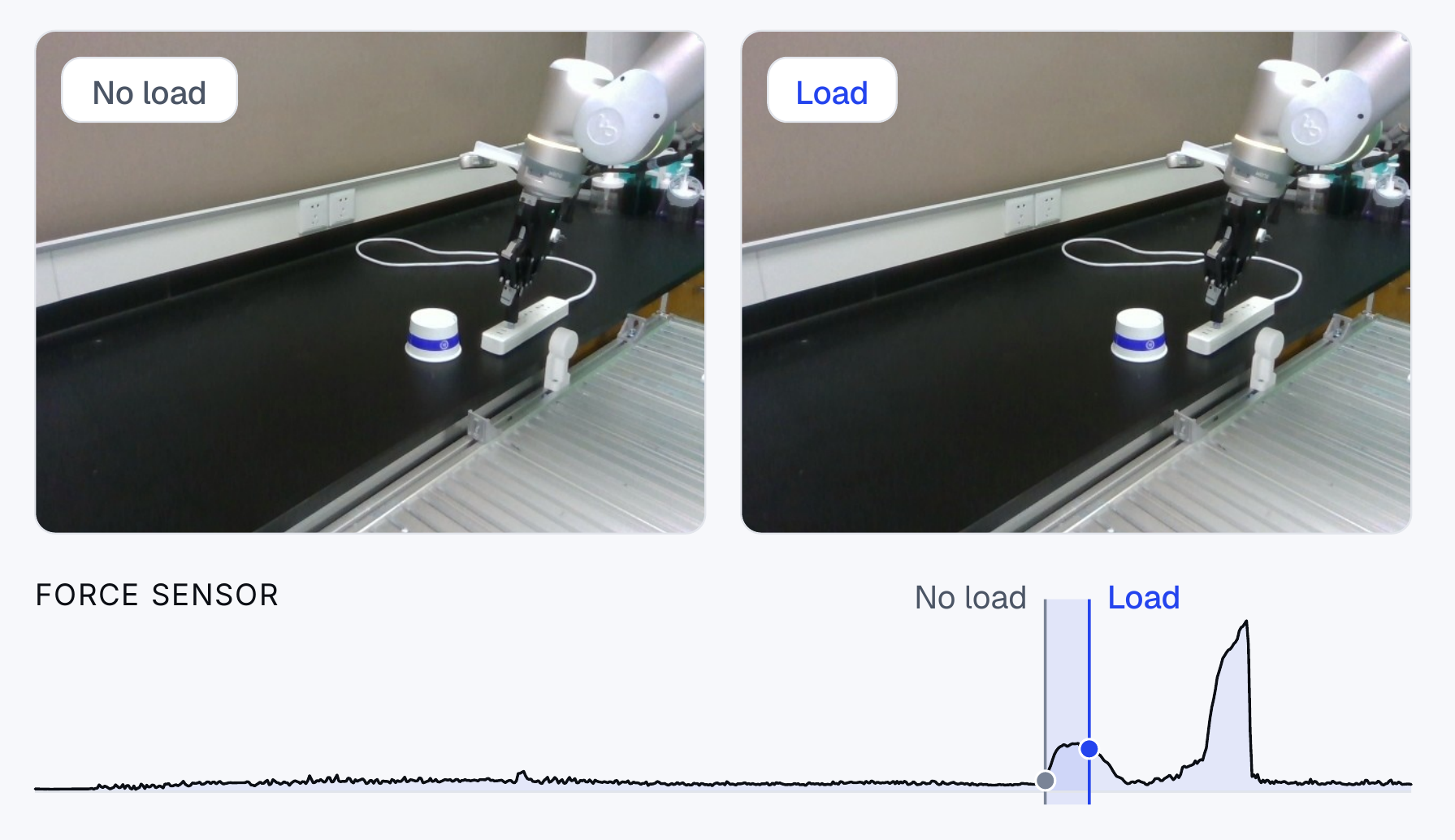
These two frames look the same. In one, the gripper is pushing with about 20 newtons. In the other, under 5 newtons.[1]
A robot that can't tell them apart drops parts, jams connectors, and waits for a person. In our simulated pick-and-place test, a policy given ground-truth contact from the simulator succeeded 63.6% of the time, against 54.8% without it.[2]
Almost no robot data carries that signal, because it takes a sensor on every robot. Video is everywhere. So can a model read it from video?
General video models are starting to label robot data and to judge whether a grasp held. Until now there was no shared way to check whether they see when force starts.
Today we're releasing OnsetBench. Models get robot video. Synchronized force sensors provide the answer key.
What it measures
The main tracks use 83 recordings of a robot arm doing assembly work, drawn from the public REASSEMBLE dataset. They ask two questions.
- Loading onset: when does a sensor-measured force change begin?
- Loading state: is sensor-defined loading present at the midpoint of a video window?
The onset track has 3,898 reference events. A prediction counts when it lands within 200 milliseconds of the sensor time, matched one to one.[3]
The definitions matter. First touch, bearing load, and a change in force can happen at different times. If one person marks first touch and another marks the first measurable load, they disagree before any model is involved. A force sensor gives everyone the same reference.
A model may also answer "unknown." The benchmark reports how often each model answers, so precision and coverage are read together.
Where models stand
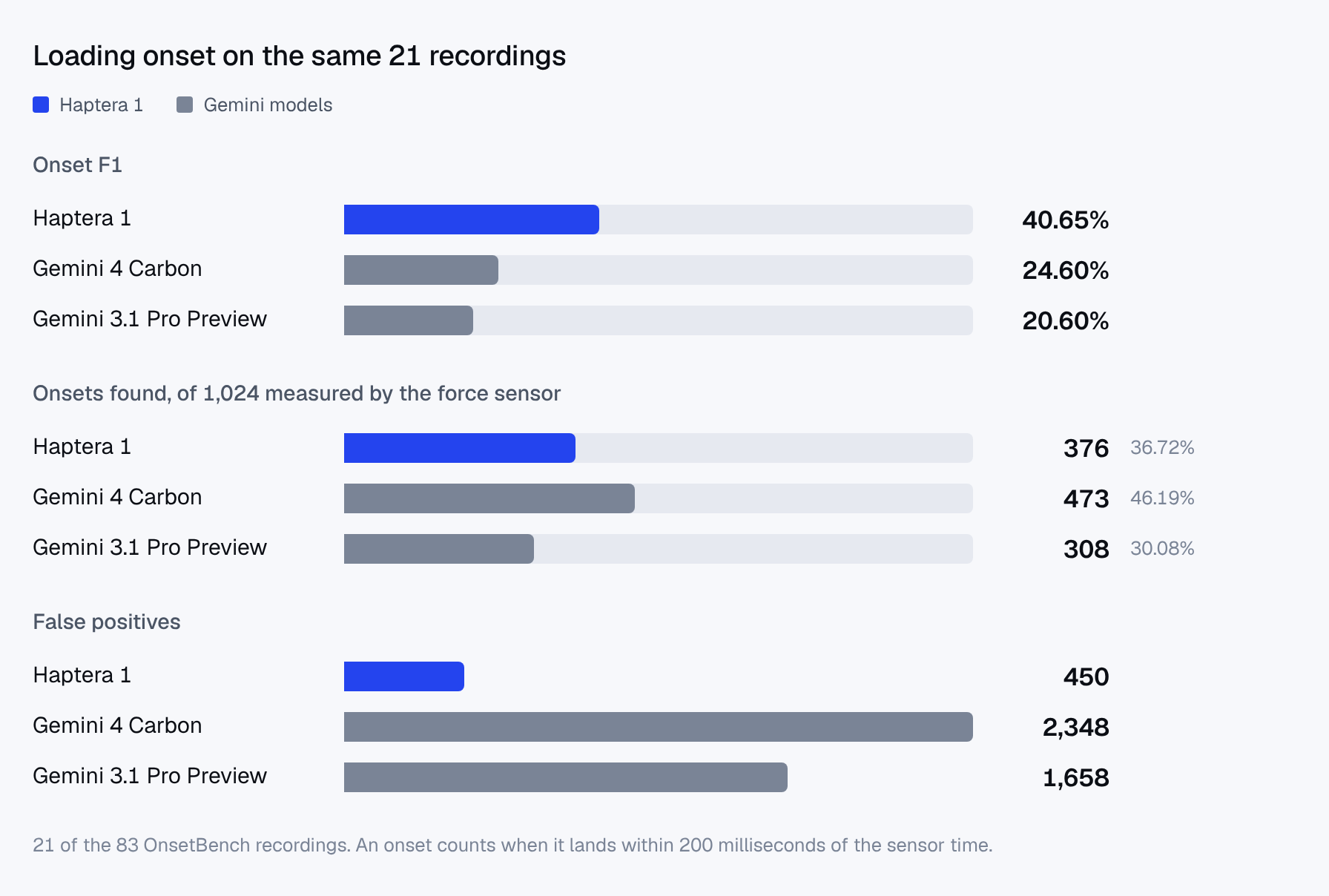
Google released Gemini 4 Carbon this month. We ran it on a random 21 of the 83 recordings, with a prompt written from the benchmark's definitions. Every row below is scored on those same 21 recordings.[3]
Loading onset
Scroll to see all columns.
| Model | Onset F1 | Precision | Recall | Onsets found | False positives |
|---|---|---|---|---|---|
| Haptera 1 | 40.65% | 45.52% | 36.72% | 376 | 450 |
| Gemini 4 Carbon | 24.60% | 16.77% | 46.19% | 473 | 2,348 |
| Gemini 3.1 Pro Preview | 20.60% | 15.67% | 30.08% | 308 | 1,658 |
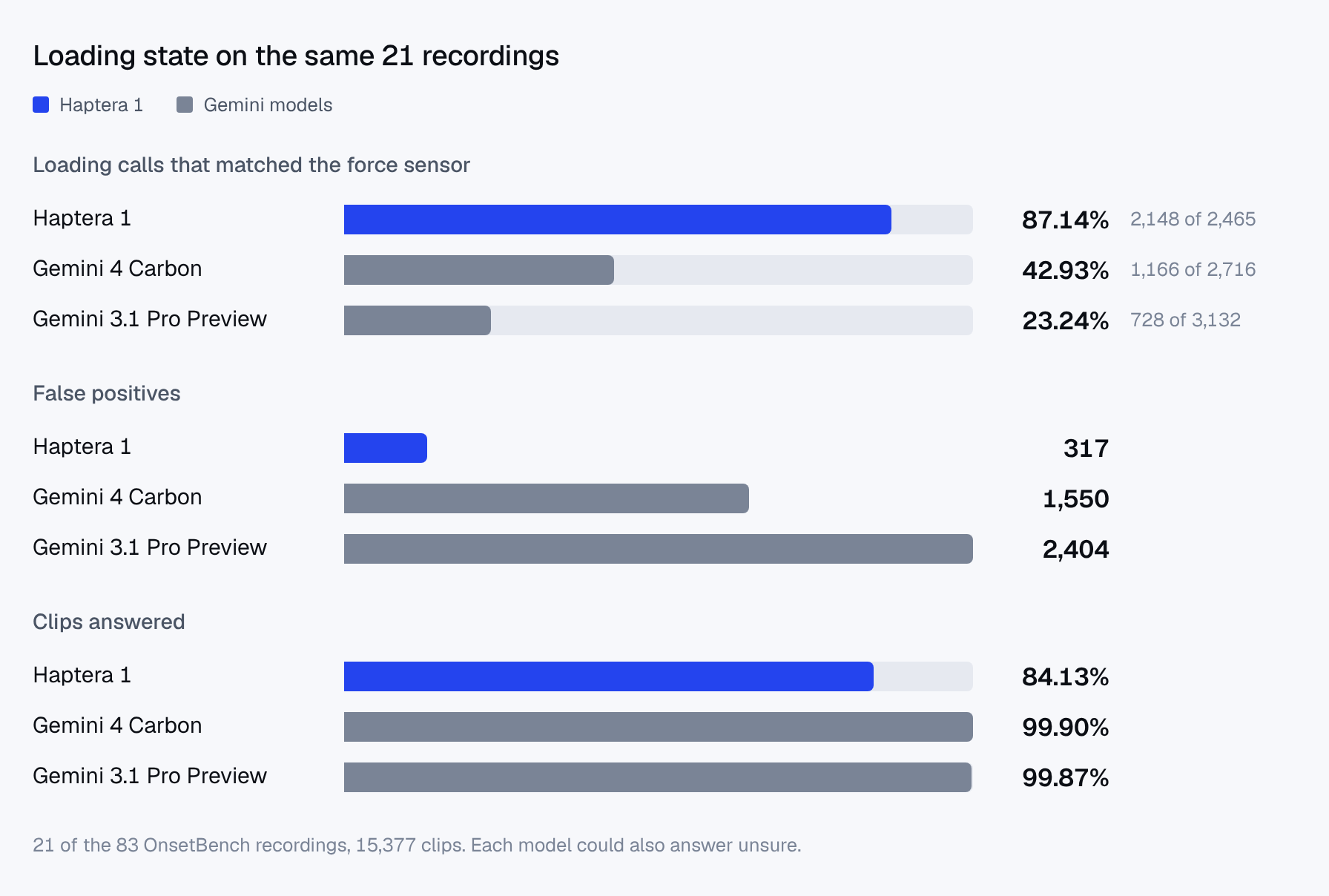
Loading state
Scroll to see all columns.
| Model | Loading precision | False positives | No-loading precision | Loading recall | Coverage |
|---|---|---|---|---|---|
| Haptera 1 | 87.14% | 317 | 99.77% | 70.84% | 84.13% |
| Gemini 4 Carbon | 42.93% | 1,550 | 85.33% | 38.46% | 99.90% |
| Gemini 3.1 Pro Preview | 23.24% | 2,404 | 81.25% | 24.01% | 99.87% |
Gemini 4 Carbon found the most onsets: 473 of 1,024, against 376 for Haptera 1. It also raised more than five times as many false positives. That is the gap between 40.65% and 24.60% F1.
Every model here still misses most onsets. There is a lot of room.
Loading state shows the same pattern. Carbon could answer "unknown", and it still answered 99.9% of clips. Fewer than half of its loading calls were right, with 1,550 false positives. Haptera 1 answered 84% of clips, was right on nearly nine in ten, and raised 317. Of the 884 loading clips it missed, it said unknown on 860 and wrongly said no loading on 24.
Carbon is also a clear step up from its predecessor. Both answered almost every clip. Carbon's loading calls were right 43% of the time, against 23% for Gemini 3.1 Pro Preview.
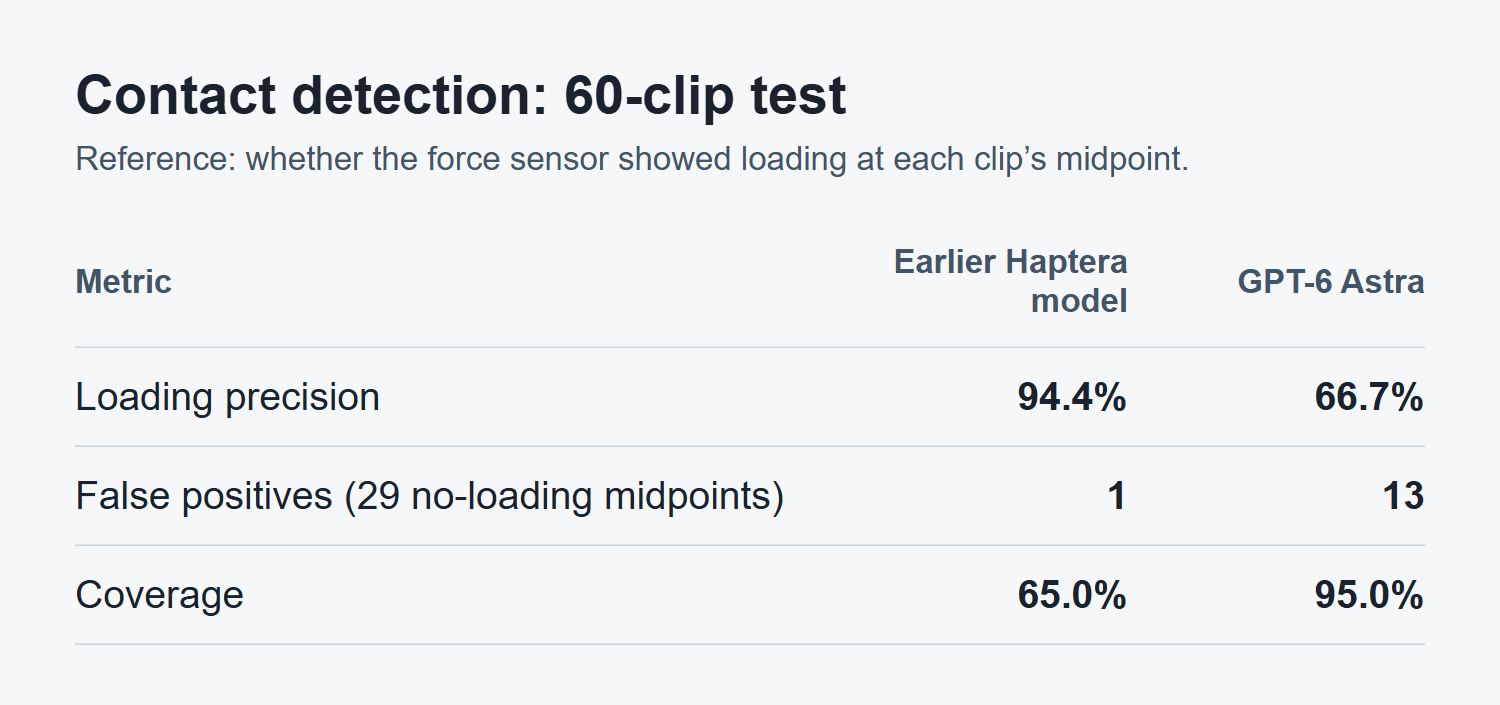
OpenAI's GPT-6 Astra shows the same trade in a smaller, earlier test. On 60 clips in September, Astra answered 95% of them, and 67% of its positive answers matched the sensor. It raised 13 false positives across the 29 clips with no loading at their midpoint. An earlier Haptera model answered 65%, matched on 94%, and raised 1 false positive.[4]
Two things to keep in mind. Haptera 1 was trained on public recordings from this robot, and the general models were not. The Gemini 3.1 and Astra results also used an earlier prompt that asked about visible touch, so the step from 3.1 to Carbon reflects the prompt as well as the model.[3]
On the full 83 recordings, Haptera 1 scores 41.36% onset F1 and 91.40% loading precision. Full results are on the results page.
We invite OpenAI, Google DeepMind, Anthropic, and any robotics or video-model team to submit, with the prompts and input settings that suit their models.
Our own model
At Haptera, we're building tactile foundation models. Haptera 1, our first, reads contact from ordinary video. Force sensors teach it. Cameras run it.
Haptera maintains the benchmark and contributes an entry. The definitions, scoring rules, and results are open for others to inspect and challenge.
Run it
The scorer is public on GitHub. The 40-recording starter kit includes video, frame timestamps, and sensor references. Download the recordings, generate predictions with your model, and score them locally.
Official evaluation uses a separate 83-recording package with the reference labels withheld. The getting-started instructions cover both routes.[5]
To get contact labels on your own robot recordings, talk to us.
What comes next
Seeing touch is the first question. In simulation, ground-truth contact raised success by nearly 9 points. Next, we're exploring how much of that a model can recover from video.
Methods and sources
- Frame pair. Two moments 0.8 seconds apart in one ForceVLA recording of a USB insertion, third-person camera. Wrist force was 19.65 N at the loaded moment and 4.62 N at the other. The gripper is closed on the plug in both. The trace is the recording's wrist force magnitude. Frames and force data: ForceVLA.
- Pick-and-place. Simulation, with 900 rollout attempts per condition. The true-signal condition used simulator contact labels in training and the simulator's contact signal at execution; the baseline had neither. At 140,000 training steps, success was 63.6% against 54.8%, a gain of 8.8 points with a 95% interval of +2.3 to +15.7. At 20,000 steps it was 54.0% against 40.0%.
- OnsetBench comparison. The three rows are scored on the same 21 of the 83 recordings, drawn at random: 1,024 sensor onsets and 15,377 video windows, at the ±200 ms tolerance. Gemini 4 Carbon ran once, on November 26, 2026, at Google's default settings, with a prompt that gave it the benchmark's sensor rule for loading. The Gemini 3.1 Pro Preview row is that model's September answers on the same recordings, to an earlier prompt that asked about visible touch. Overlapping clips can report one onset twice; each is counted once for both Gemini rows. Haptera 1 leads Carbon by 16.1 points of onset F1 (95% interval +13.9 to +18.5) and 44.2 points of loading precision (+40.6 to +47.8). Haptera 1's full-83 figures come with 46.06% onset precision, 37.53% recall and 84.09% coverage, and reproduce with the public scorer. The open V-JEPA2 and DINOv2 task baselines score 12.09% and 4.15% onset F1 on the 83. Haptera 1 was trained on public REASSEMBLE recordings that are separate from the 83.
- GPT-6 Astra test. September 7, 2026, model gpt-6-astra at its highest reasoning setting. Sixty 0.8-second clips from 20 recordings: 20 selected for onset, 20 for sustained loading, and 20 from the no-loading group. At the scored midpoint, 31 clips had loading and 29 did not. Onset clips can be negative at their midpoint. This separate test is not comparable with the 21-recording results. Astra saw 20 timestamped frames per clip and the earlier prompt that asked about visible touch. Astra: 26 of 39 positive answers matched the sensor, 13 were false positives, and 57 of 60 clips were answered. The earlier Haptera model: 17 of 18 matched, 1 was a false positive, and 39 of 60 were answered.
- Release materials. Scorer, starter kit, and official evaluation instructions. The 40-recording starter is a development resource; official scoring uses the separate 83-recording evaluation set.